February 21, 2026 · 5 mins read
Santosh Kumar
Your credit report is crucial for your financial credibility in India. If you apply for a loan or credit card or even check your own credit score, your credit report notes that. Of the various terms you’ll see in your report, soft enquiry and hard enquiry are two significant ones that pertain to when your credit information is accessed.

Your credit report is kept by credit bureaus like TransUnion CIBIL, which track and store information about your borrowing and repayment habits. Every time your credit information is viewed, it is logged as an enquiry on your report. These are categorized into soft enquiries and hard enquiries, and each affects your credit score in a different way.
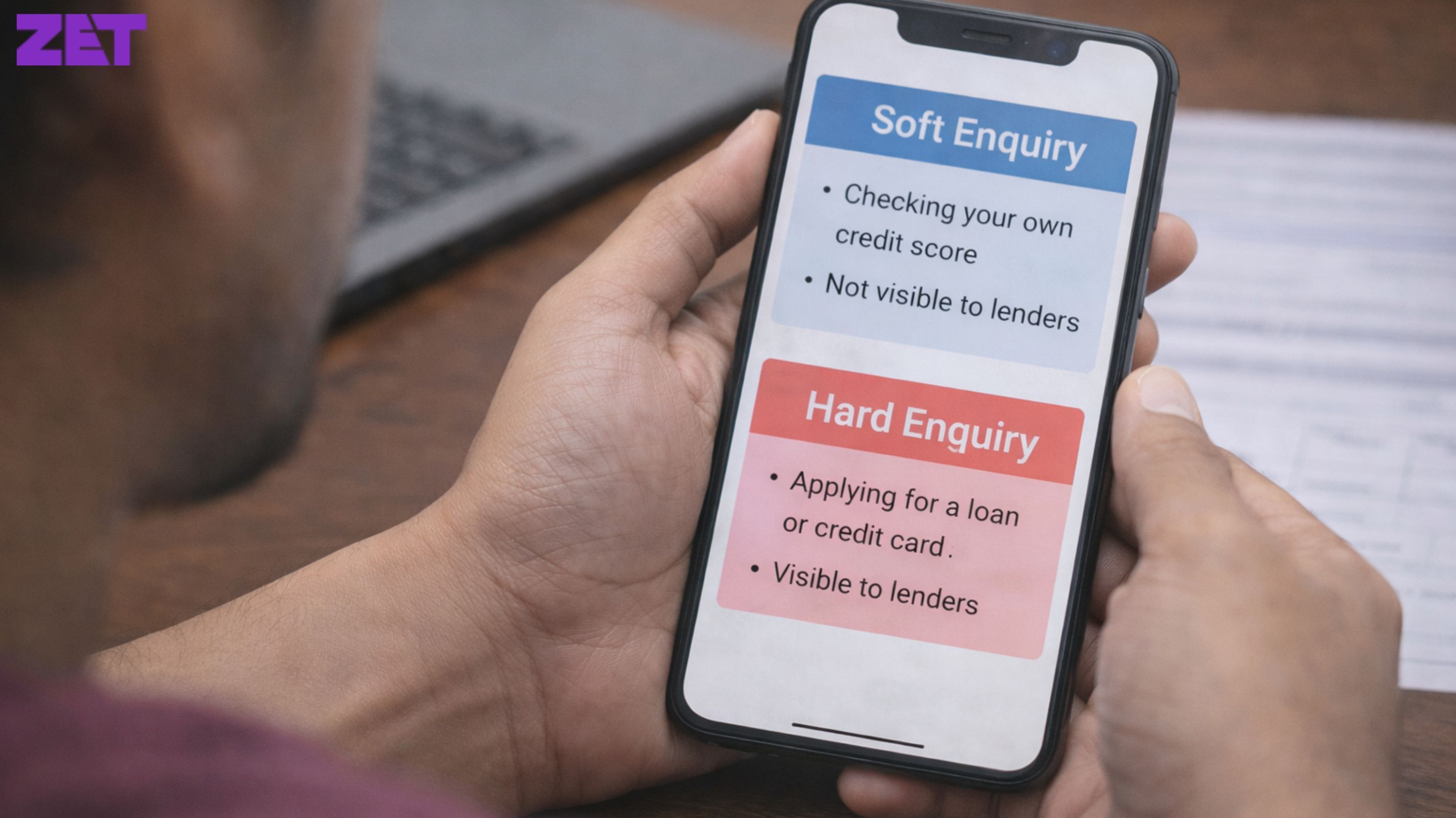
A soft enquiry is when your credit information is accessed for information and not for credit giving. This kind of enquiry doesn’t impact your credit score and is typically only visible to you on your credit report.
Soft enquiries tend to occur when you pull your own credit score or report. There are also soft checks that banks can do to pre approve loan or credit card offers. Employers or companies performing background checking also occasionally check credit info via soft enquiries, depending on their policies. Because soft enquiries have nothing to do with active borrowing decisions, they don’t signal credit risk. They just indicate that your credit information has been pulled for inquiry or evaluation.
For instance, if you track your credit score to keep tabs on your financial health, each time you do is noted as a soft enquiry and does not affect your creditworthiness.
Also Read: Best Credit Cards In India You Can Get On A ₹2,000 FD (2026 List)
A hard enquiry occurs when a lender or financial institution accesses your credit report to determine your qualification for a loan or credit card. This usually occurs when you apply for credit.
Hard enquiries are more meaningful as they indicate your intent to take a loan. When a bank checks your credit file prior to approving you for a personal, home or vehicle loan, or credit card, the enquiry is a hard enquiry. Unlike soft enquiries, hard enquiries may have a minor effect on your credit score. One enquiry typically just creates a small, temporary dip. But several hard enquiries in a short time could cut your score more, since they imply greater reliance on credit or financial trouble.
Lenders consider frequent credit applications as risky behavior, hence why controlling the quantity of hard enquiries is crucial.
Also Read: ₹2,000 FD Credit Card Limit: How Much Limit Can You Get?
The point of distinction between soft and hard enquiries is more about their intent and effect. Soft enquiries are for information or review and do not impact your score. Hard enquiries take place when you actually apply for credit and can affect your score.
Another key distinction is visibility. Soft enquiries are typically only visible to the borrower, while hard enquiries are visible to lenders checking your credit report.
And soft enquiries don’t reflect borrowing behaviour either, while hard enquiries do – meaning that you’re seeking credit and that lenders may view you as more financially responsible.
Also Read: How a ₹2,000 FD Credit Card Helps Build Your CIBIL Score Fast
Hard inquiries play an important, though small, role in calculating your credit score. Depending on the frequency of hard inquiries, a couple of inquiries won't usually have a large negative effect on your score, but applying for a lot of credit can reduce your credit score.
While the effects of hard inquiries are usually only temporary, as long as you use credit responsibly and pay your bills on time, it is only a matter of time until you recover from the damage done by hard inquiries.
Although both soft inquiries and hard inquiries show when your credit information has been requested, they serve different purposes and have differing impacts. Soft inquiries are harmless and typically occur for review purposes only while hard inquiries are generated by applications for credit, and can result in a minimal impact on your credit score. Knowing and understanding these differences will enable you to make well-informed decisions about your finances, to manage your credit appropriately and maintain a good credit history over time.
Also Read: How to Apply for a ₹2,000 FD Credit Card on ZET App: A Step-by-Step Guide?
Your own credit score isn't affected by checking it; it counts as a "soft inquiry" against your credit file.
There are no hard-and-fast rules regarding this number. However, if many applications are submitted in a short amount of time (e.g., within 30 days), those applications could hurt your chances of being approved for credit.
Different credit bureaus have different retention periods for "hard inquiries,” but most retain these inquiries in their credit files for several months or years, depending on the credit bureau’s policies.



Contact

care@zetapp.in
Social


Build and Maintain a 750+ Credit Score