January 26, 2026 · 9 mins read
Santosh Kumar
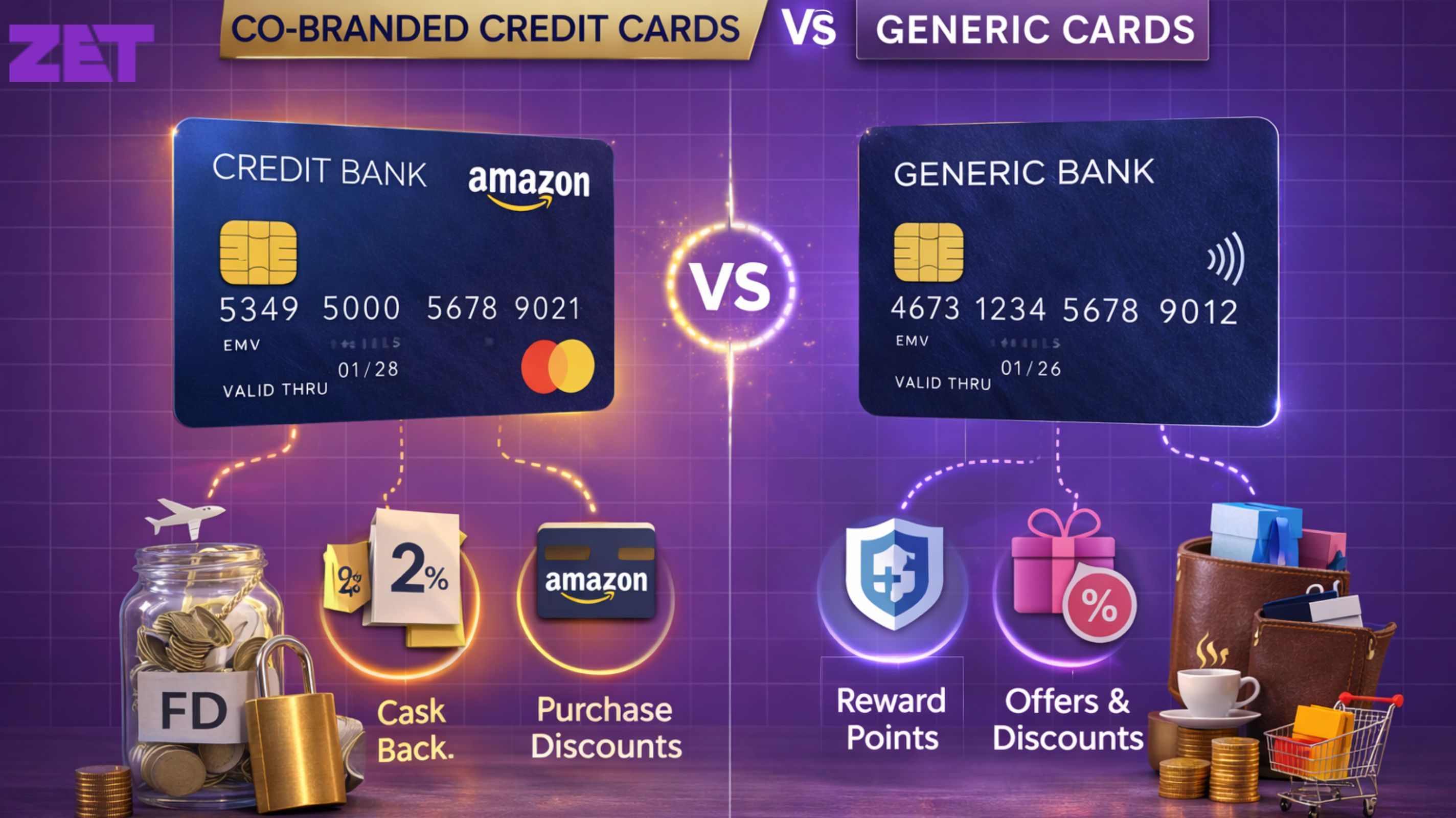
When deciding between both co-branded and generic credit cards, users shouldn't just look at rewards and fees. A credit card should also reflect a user's lifestyle, spending habits and plans. Both co-branded and generic credit cards provide value, convenience and financial flexibility in different ways. Generic credit cards provide widespread appeal, while co-branded cards focus on a specific partnership/brand relationship. Understanding how their benefits differ will assist users in making an informed choice with greater confidence.

Generic credit cards appeal to the maximum number of users by offering rewards independent of any specific brand or platform. Most have reward structures that focus on universal categories for all types of spending, meaning you can earn rewards wherever you choose to shop.
Generic credit cards provide great freedom for consumers because they do not restrict spending to any particular merchant(s) or service. Thus, consumers have the ability and freedom to spend in any way they choose.
In addition, generic credit cards provide a simple way to earn rewards. They have reward systems that are easier to understand and redeem compared to many other types of credit cards. This makes them ideal for consumers who want a credit card that has a simple and predictable financial management process. By using a simple card for a long period of time, consumers can reduce the fatigue of making multiple decisions regarding their reward program and feel more in control of their personal finances.
Partnerships between brands and financial institutions yield co-branded credit cards. These cards have advantages centred on improving the relationship that customers have with the brand. Rather than providing generic rewards, co-branded credit cards are designed to provide greater value within the parameters established by a specific brand's ecosystem. This allows for a greater personal connection to the product for the customer who already purchases from or engages with the partner company.
Co-branded credit cards also offer an emotional benefit to customers. As opposed to merely being payment methods, co-branded credit cards represent an affiliation with a particular company. When a customer uses a co-branded credit card to make a typical purchase (e.g., groceries), he/she may feel more connected to the company and therefore perceive the typical transaction as more important. The emotional connection created by the co-branded credit card may result in customers perceiving these credit cards as having a greater value than standard credit cards since customers feel acknowledged and rewarded for their loyalty.
Also Read: How a ₹2,000 FD Credit Card Helps Build Your CIBIL Score Fast
Flexibility is the most significant distinguishing characteristic of generic and co-branded cards. The flexibility of generic cards is their biggest selling point. Because of this characteristic, generic cards can be used across multiple shopping/financial situations. The values of generic cards remain consistent because they can adapt to changes in your living pattern.
Co-branded cards, on the other hand, are much narrower in their value. They tend to reward their users for making purchases related to the specific brand(s) with which they are connected. As such, co-branded cards can often provide greater perceived value than generic cards, but they have less flexibility. Some consumers prefer to receive benefits on their co-branded cards due to the concentrated nature of the benefit.
Also Read: How to Get a Credit Card with Just a ₹2,000 FD in India
Due to the nature that generic credit cards are devised for general users, they offer a high degree of simplicity. Since the systems are created to be simple and transparent, they tend to have fewer constraints and clearer guidelines for how to redeem the benefits associated with the card, thus making them appealing to consumers who wish to easily control their spending. Because it is easy to understand the mechanics behind credit card rewards, this adds to the attractiveness of these generic cards. With co-branded credit cards, many of them involve much more complex structures.
While complexity can make co-branded credit cards seem overwhelming, complexity allows cardholders to have experiences tailored to their specific needs. If a cardholder enjoys discovering new or different card benefits and how to optimise their card's rewards, then the complexity of a co-branded credit card may be attractive to them.
Also Read: UPI vs Wallet Payments: Which One Should You Use?
Generic credit cards offer a level of long-lasting consistency. Generic credit cards are not tied to brand partnerships, meaning that the benefits do not change or fluctuate due to the activities of other companies or individual brands. This long-lasting stability breeds trust and confidence, as a consumer can continue to use the same generic credit card for an extended time period without having to worry about a large change to the card's benefits. The stability associated with co-branded credit cards comes from the cardholders' emotional connection with the partnering brand.
Co-branded credit cards continue to hold value for cardholders, provided the cardholder maintains loyalty to the partnering brand. While the stability of co-branded credit cards is much more unique and less widely applicable than that of generic credit cards, the strength of the stability associated with a co-branded credit card can be equally strong.
Also Read: How to File NIL GST Return Online
The primary value of a generic card is practical, as it provides generic support to anyone. Users can use the card for anything without having to worry about being told how to use it or spend. The lack of specifics keeps it flexible and ultimately gives the user confidence. The emotional value associated with co-branded cards provides not only functional benefits but also reinforces user loyalty through identity-based spending. Users may develop a deeper emotional attachment to co-branded cards than generic cards, even though the tangible benefits are often equal.
Generic cards tend to reward users equally across all types of purchases. Therefore, calculating or managing the value of a generic card is relatively simple. Users can budget and anticipate all spending without the risk of missing benefits. On the other hand, co-branded cards concentrate rewards within their ecosystem. Therefore, loyal users will perceive they are earning rewards at an accelerated rate simply because those rewards are available exclusively to loyal users. The perception of exclusivity enhances the experience for loyal users.
Also Read: Documents Required for GST Registration for Different Business Types
Generic Cards have a single objective: they should be universally accepted and have little to no restrictions. Since generic cards are designed to work anywhere a generic card is valid, this means they are perfect for people who prefer to keep their day-to-day transactions simple. Co-Branded Cards usually fit much better into a specific ecosystem or service. When a co-branding card fits into an ecosystem, it gives the user a better experience when using that card in that environment, making using a co-branding card more satisfying than using a generic card.
Generic cards will neutrally promote your spending. Therefore, generic cards do not encourage you to select one brand over another. Because of this neutrality, generic cards allow you to make independent decisions on what you purchase. Co-Branded Cards will influence your spending by developing and reinforcing your loyalty to a specific brand. For most users, the positive influence of this loyalty enhances their enjoyment and rewards from their financial relationships.
Also Read: GST for E-Commerce Sellers: Rules & Compliance Checklist
Co-branded cards are specifically designed to build loyalty to the brand. Co-branded cards provide benefits and unique recognition systems that build long-term engagement for co-branded cardholders.
Co-branded credit cards focus on emotional connection, identity and building value through an integrated ecosystem. Generic credit card programs emphasise flexibility, neutrality, and long-term adaptability of user experiences. Ultimately, the best choice will not only be based on spending patterns, but also on how each person would like to incorporate their financial tools in their daily life. The benefits of aligning a credit card with one’s personal financial values and habits are enhanced because they support an individual’s everyday life.
The distinct advantage is the defined nature of how each offers its benefits to the user. The traditional credit card typically gives its user a more generalised range of benefits across all types of purchases, whereas a co-branded card focuses on the specific benefits available to the user from using the specified brand or service.
Yes, the co-branded card is likely to deliver more value to frequent users of the partnered brand. The increased value offered through the high level of rewards/privileges available, especially to loyal customers, makes the card highly attractive to a regular user.
Typically, a generic card will offer a greater amount of flexibility due to the fact that the rewards are not limited to a particular brand or service. It is suitable for users with varying buying behaviours or those who prefer to choose from a variety of options.
It is easier to manage a generic credit card due to the simple nature of the rewards offered for various purchases, as well as the easy way to redeem those rewards. A co-branded card may have a more complex reward structure with the potential for many benefits and terms offered by multiple brands and services.



Contact

care@zetapp.in
Social


Build and Maintain a 750+ Credit Score