December 16, 2025 · 14 mins read
Santosh Kumar
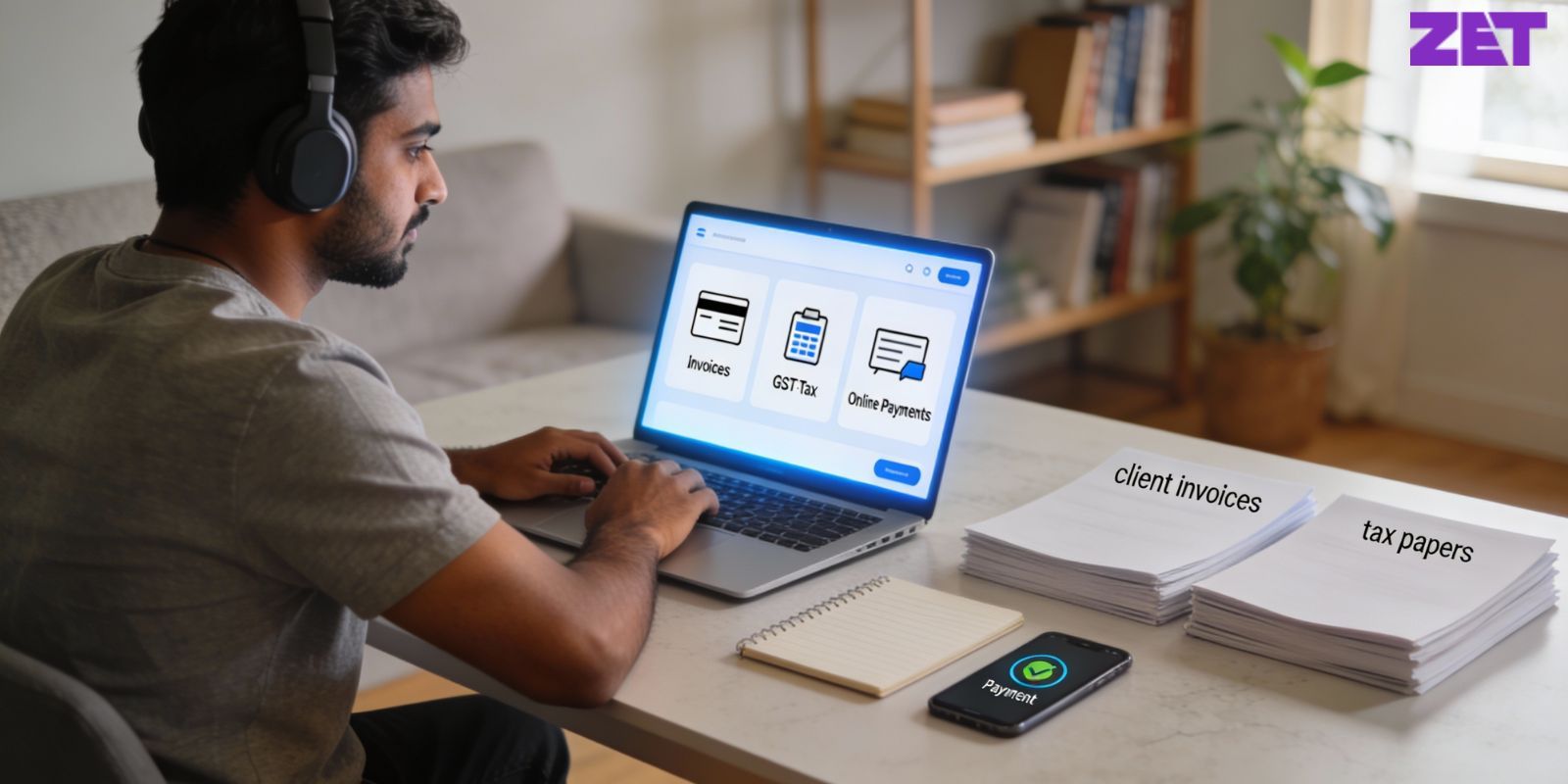
Freelancing in India itself has ballooned. From graphic designers and content writers, consultants and developers to fitness coaches and voice-over artists, the move toward flexible work and project income is gaining ground by the day. This surge also coincides with a need to grasp tax obligations. One area that often confuses independent professionals is the Goods and Services Tax (GST). How do you find out if your services are subject to GST?

Do you need to register? How does compliance work? And how do you deal with invoices and returns without putting too much effort into it? These are just some of the questions owners ask themselves when starting their business.
GST is a single, destination-based indirect tax levied on the supply of goods and services in India. Freelancers don’t sell physical goods, but their services qualify as taxable supplies under GST legislation. Code, logos, marketing consultancy, online coaching, whatever your output, it’s a service, and therefore taxable.
Freelancers should be treated as service providers like any other business. As soon as you exceed the specified turnover, or if you fall into particular categories like interstate service supply, overseas client billing or e-commerce aggregators, you’re obliged to register for GST, even if your income isn’t high.
Also Read: Annual Fee vs Lifetime Free Cards
The biggest cause for confusion is eligibility. Many freelancers think that GST only applies to the big end of the market, but the law is clear – anybody supplying services must register if they cross the basket turnover limit.
The current turnover threshold for mandatory GST registration for service providers is ₹20 lakh per year (₹10 lakh for special category states). If your freelance income exceeds this threshold in a given tax year, you have to register for GST.
But turnover isn’t the sole deciding factor for qualification. You will also need to register for GST if you serve clients outside India, if you collaborate with specific online platforms that require GST-registered service providers, or if you choose to register voluntarily to boost your business credibility.
Also Read: Credit Card Cash Advance
Many freelancers, particularly those working with corporate clients, opt for voluntary GST registration before they hit the threshold. This is because many businesses like to deal with GST-registered providers so they can claim input tax credit (ITC) on their payments. Voluntary GST registration can make your freelancing business look more polished and professional.
However, voluntary registration also comes with other responsibilities, such as regular filing of GST returns and maintaining books of accounts. So you’ll need to weigh up whether those advantages are worth the compliance burden for your type of work.
Nearly all freelance professional services fall within the GST increase bracket if they are similarly qualified. Examples include:
1: Content writing, editing, copywriting, and technical writing
2: Graphic design, animation, and video editing
3: Web development, app development, software design, and cybersecurity services
4: Social media management, SEO, digital marketing consultancy, and branding services
5: Photography, videography, and creative production
6: Financial consultancy, business coaching, project management, and HR services
7: Online tutoring, workshops, training sessions, and education-based services
8: Fitness coaching, yoga instruction, and wellness sessions are conducted online or offline
So, whether you’re working from home, a co-working space, or on the road, GST applicability is determined by the service you offer and your annual income, not where you work.
Also Read: Credit Card Renewal & Replacement
Most freelancing services fall under the 18% GST slab, unless they are specifically exempt. For instance, educational services provided through approved institutions or certain health services could be excluded. But most creative, technical and other professional services levy 18 per cent GST.
If you’re not sure what the rate is for your type of service, 18% is probably a safe bet, as that’s the standardised rate for all service providers.
To complete GST registration for freelancers, you will typically need:
1: PAN card and Aadhaar card
2: Proof of address, such as an electricity bill, rental agreement, or property tax receipt
3: Bank account details, including a cancelled cheque or bank statement
4: Passport-sized photograph
5: Email address and phone number linked with Aadhaar
6: A digital signature if registering as a company or LLP
The registration is completely online via the GST portal, which is easy and convenient for freelancers.
Also Read: Types of GST Registration in India
Registering for GST is straightforward enough, though you need to get your records in order and enter your business details correctly.
In this guide, we’ll be taking you through the online registration process step-by-step. To begin with, you must go to the official GST site and click on the ‘New Registration’ tab. You enter your PAN, mobile number, email ID, and OTPs are sent for authentication. Next, you’ll fill out an application form, supplying business information, address confirmation, bank account details and other relevant information.
When everything is checked and submitted, you’ll be given an Application Reference Number (ARN). The tax office then typically takes a few business days to approve the application, after which, your GSTIN (Goods and Services Tax Identification Number) is issued. As soon as you obtain your GSTIN, you will have to start featuring it on invoices and other documents.
Also Read: What is UPI 2.0?
When you register, you also have to comply with the taxation law’s invoice rules. A GST-compliant invoice should contain:
1: Your name, address, and GSTIN
2: The customer’s name, address and GSTIN if applicable
3: A unique invoice number
4: Invoice date
5: Description of services provided
6: Taxable value of the services
7: GST rate and amount
8: Total invoice value including GST
9: Place of supply
10: Signature or digital signature
Companies depend on these invoices to claim back input tax credits, which is why accuracy is paramount. Implementing a good invoicing tool can facilitate this.
Also Read: How To Invest in Post Office FD?
On the other hand, with GST registration, you can claim input tax credit on business expenses. If you’re registered voluntarily or forced by turnover, you can claim ITC on and such as:
1: Software subscriptions
2: Internet services
3: Co-working space rent
4: Professional equipment
5: Office supplies
6: Advertisement and marketing costs
Claiming ITC can reduce your overall tax liability. But make sure the bills are in your name, and the company you buy from has filed its GST returns properly.
Also Read: Can We Invest Monthly In FD?
Filing returns is another aspect that loads of freelancers stress over, but with the right routine, it’s doable. On the regular scheme, however, freelancers must file GSTR-1 monthly or quarterly, detailing outward supplies, and GSTR-3B monthly, summary tax payments.
Deadline penalties are hefty, so make sure to ring-fence time for accounts reminders yourself or get an accounting professional on board if it all gets too much. So many freelancers delegate their GST returns to avoid mistakes on that as well and to remain compliant without wasting time.
The biggest issue comes when freelancers work for foreign clients. Export of services is exempt under the GST regime. “If you’re exporting most things, it’s zero-rated, so you don’t charge your foreign customer GST. But to consider your work an “export of services”, you need a legitimate GST registration.
Either would work with export services:
1: Export under Bond/LUT without charging GST
2: Charge IGST on the invoice and claim a refund later
For many freelancers, providing services under a Letter of Undertaking (LUT) is the easiest route. It keeps you competitive with the world by not making foreign clients pay GST.
Also Read: How to raise your credit score by 200 points
Freelancers providing services via platforms like Upwork, Fiverr, UrbanPro, or online tutoring sites must be aware of platform-specific GST rules. Some platforms are intermediaries that will collect GST on your behalf, while others will ask for a GSTIN before you can get paid.
If you’re selling via e-commerce aggregators, then you might have to register for GST regardless of turnover, depending on the category of service. Always read the platform’s terms and conditions to ensure you are compliant.
Operating without GST registration when you’re legally required to have one can result in stiff fines. There are also interest and late fees attached to not filing returns or filing incorrect ones. As a freelancer, not incurring late fees is critical because it impacts your earnings.
Having good records and holding onto invoices and receipts, as well as filing dates, ensures smooth sailing.
Although compliance can initially seem like a headache, GST has multiple long-term benefits:
1: Builds trust and credibility with corporate clients
2: Allows freelancers to work with global clients more professionally
3: Enables the claiming of input tax credit
4: Helps maintain organised financial records
5: Makes scaling into a larger business easier in future
“GST compliance brings order to your financials, and helps you establish yourself as a credible service provider in a competitive marketplace.”
India's GST system has created a simplified tax scheme through Composition Scheme. This will allow smaller and less compliant taxpayers to ease compliance by not filing their respective tax returns and filing fewer tax returns. Businesses that are eligible for the Composition Scheme may pay their taxes based on the turnover of the business at a fixed rate rather than the standard rates of GST; therefore, the business has to file fewer returns and has simplified its procedures. However, applicability to freelancers depends on what type of services they provide and if they meet the eligibility criteria set forth under GST Regulations.
Freelancers are typically classified under GST as providing services. The Composition Scheme's primary focus is on small businesses that provide goods; however, Government of India has created a separate composition scheme specifically for service providers who do not have a large business and/or mixed supply service providers (to transfer from goods to services). Freelancers may utilize the formation of new Composition Scheme but will have to adhere to certain eligibility conditions in relation to their aggregate annual turnover of ₹50 lakh during their Financial Year.
Freelancers who use the composition scheme will have to pay GST at a fixed rate of their turnover instead of taking credit for the GST they charge on their services. The benefits of the composition scheme are its reduced complexity in GST calculations and keeping records. However, one of the main drawbacks to the composition scheme is freelancers cannot collect GST from clients nor claim a credit for any input taxes on business expenses, thus making GST paid a cost to the freelancer.
In addition to these limitations, freelancers under the composition scheme will only be able to provide services to clients within their registered state. The freelancer must include certain declarations on invoices indicating that they are paying GST under the composition scheme. Freelancers will need to weigh whether the benefits of reduced compliance outweigh the restrictions of being unable to claim an input tax credit and provide services out of state before deciding if the composition scheme is a good fit for their business, especially for those providing services to clients throughout India.
Yes, it is mandatory for freelancers registered under Goods and Services Tax (GST), whether they register under the composition or normal scheme to file their tax returns. Filing your tax return with the GST is necessary to keep track of taxes paid and collected to comply with tax regulations. The government tracks and identifies business transactions through this process and ensures compliance with their regulations.
If you are a freelancer under the normal GST scheme also known as the regular scheme, you must file your GST returns periodically. Your returns must include your total sales, tax due, tax paid, and any claim regarding your input tax credit (ITC) for services provided by you. Your returns must be filed according to the date specified in the regulation to avoid penalties, interest charges, or avoiding having your GST registration suspended.
If you are a freelancer under the GST composition scheme, you will find your filings more accessible than being under the normal GST scheme. Instead of filing multiple returns throughout the year, you generally have the option of filing quarterly statements and an annual return - your turnover and tax due quarterly, along with an annual return. You still must file quarterly and annually regardless of the number of returns required.
On the GST Portal, taxpayers must complete their GST return submission via online means with their relevant (valid) logins; this is an online service that allows you to report transactions, pay your taxes, and keep track of when you have submitted your returns.
If you do not have any business activities or taxable transactions during a specific period, you may still be required to lodge a (nil) return based on your GST registration status. Not lodging your returns on time can lead to penalties, late fees and/or restrictions on the operation of your business.
In addition to meeting your legal obligations, lodging your returns on time will provide you with the necessary records to assist you with preparing financial records and build a good reputation with potential clients and financial institutions as well as provide you with a level of assurance that you will be able to communicate effectively with tax bodies and avoid the possibility of future disputes relating to your tax liabilities.
No. GST becomes compulsory only if your annual turnover exceeds ₹20 lakh, or you provide services to other states, foreign clients (in certain instances), or specific online platforms. If not, you can opt for voluntary registration.
“Most freelancer services comfortable with 18% GST. Certain niche services might be an exception, but the vast majority fall under the normal 18% slab.
Yes – you want your services to be considered exports, and the zero-rated advantage? You should have a GSTIN to file an LUT or claim a refund of IGST paid.
Yes. If registered under GST, freelancers intend to claim ITC on business expenses like software, internet, equipment and professional services, as long as they have valid GST invoices.
Enrolled freelancers submit GSTR-1 for outward supplies and GSTR-3B for summary tax. This can be monthly or quarterly, depending on their filing scheme.
Most platforms need a GSTIN for payouts if they’re e-com operator. Examine your platform’s individual rules.
Yes. Freelancers can also voluntarily register for GST if their earnings don’t cross the compulsory threshold, to appear more credible, work with businesses, and claim input tax credits.



Contact

care@zetapp.in
Social


Build and Maintain a 750+ Credit Score