December 17, 2025 · 10 mins read
Santosh Kumar
India’s move to the Goods and Services Tax (GST) represented one of the largest restructurings of the nation’s tax system. It rationalised countless indirect taxes into a single, clear, destination-based tax system. To make GST work effectively across millions of businesses—ranging from small shop owners and freelancers to large companies—the system introduced a unique mechanism for identification and compliance: the GSTIN.

To find out how GST-compliance is crucial for businesses in India, and learn more about what knowing your GSTIN means to you, you’ll have greater power over finances, invoicing, returns-filing, and tax life. For many new entrepreneurs, the first question that arises is: What is my GSTIN number?
GSTIN stands for Goods and Services Tax Identification Number. It is a unique 15-digit alphanumeric code assigned to every registered business under the GST regime. In essence, it serves as your tax identity – where a PAN identifies people for income tax, the GSTIN identifies businesses for GST.
If you run a business and need to register for GST, you will receive a GSTIN as soon as your application is accepted. This number should only be used for issuing invoices, filing returns, claiming input tax credit (ITC), transporting goods and communicating with the tax department. GSTIN is compulsory for businesses crossing the turnover threshold limits, inter-state suppliers, online sellers, service providers, and anyone who voluntarily registers for GST. For millions of businesses, it is a conduit to the formal tax system.
Also Read: GST for E-Commerce Sellers: Rules & Compliance Checklist
Before GST, businesses had to manage a bunch of different identification numbers – from VAT TIN to service tax number to central excise registration. Enforcement was haphazard, fragmented and frequently inconsistent between states. GSTIN addressed this by providing a pan-Indian format of ID across all indirect tax requirements. The reason for instituting GSTIN was to:
1: Standardise tax identification across the country
2: Enable seamless tracking of transactions and tax credits
3: Ensure transparency in supply chains
4: Integrate state and central tax systems
5: Reduce fraud by linking registration to PAN
6: Make record-keeping easier for both businesses and the government
Now, GSTIN is the engine of the entire GST framework. All sales, purchases, input credits, return lapses, as well as taxes owed, are reflected against a company’s GSTIN, forcing accountability in real-time.
Also Read: Annual Fee vs Lifetime Free Cards
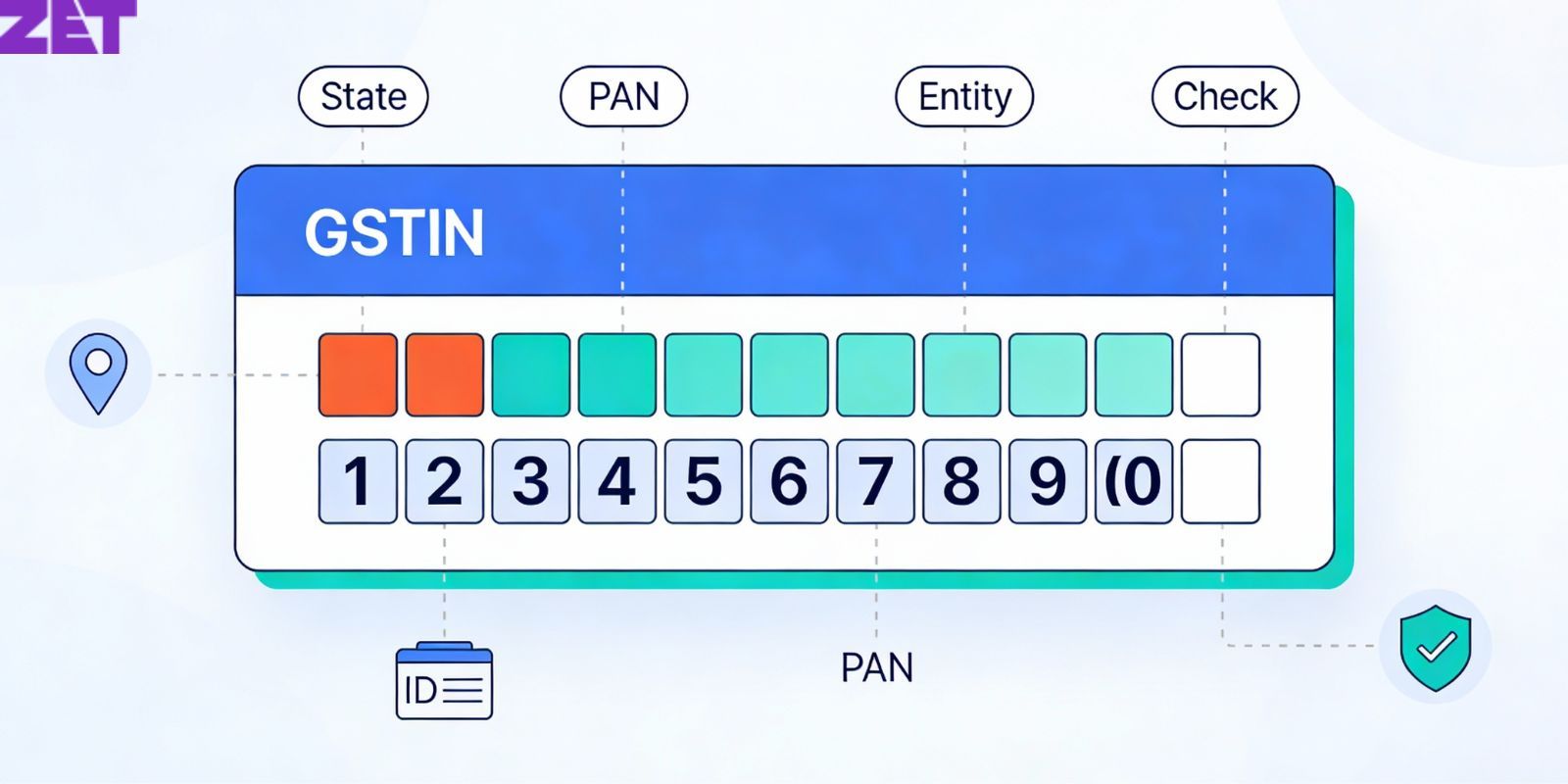
And, underpinning GSTIN, for instance, is the structure – the very structure – of the number itself. The 15-digit GSTIN isn’t a random series. It’s a sensible structure that contains key data points for the business.
Let’s break down the format:
Its GSTIN starts with a two-digit state code of the Indian Census. For example:
1: 27 for Maharashtra
2: 09 for Uttar Pradesh
3: 33 for Tamil Nadu
4: 07 for Delhi
This aids tax authorities immediately in establishing a business’s state jurisdiction.
Numbers 3-12 of the GSTIN represent the PAN of the business or individual proprietor. This ensures that the GST registration is closely connected to the income tax identification system. PAN provides the basis for GST compliance, eliminating duplicate or bogus registrations.
Also Read: Credit Card Cash Advance
This number is the number of registrations a company has in a state. A single business can have multiple branches or separate verticals, each requiring its own GST registration.
For example:
1 for the first registration in the state
2 for the second
3 for the third
So this number is the one that guarantees you that each of them is unique and distinct.
The fourteenth digit is usually the letter ‘Z’. It remains for future systems, and doesn’t need to mean anything at the moment.
The last digit is an alphanumeric checksum value for error detection. It’s generated by a mathematical equation. This also means that erroneous or fraudulent GSTINs are caught immediately.
Every element of the GSTIN contributes to it being a streamlined identification system, resistant to tampering and simple to verify.
Also Read: Credit Card Renewal & Replacement
Here’s what a GSTIN usually looks like:
33ABCDE1234F1Z5
Breaking this down:
1: 33 → State code (Tamil Nadu)
2: ABCDE1234F → PAN
3: 1 → Entity number within the state
4: Z → Default letter
5: 5 → Checksum
Once you know the format, you can guess the state it is from pretty rapidly, and check if the number corresponds to a valid PAN.
Also Read: Types of GST Registration in India
GSTIN isn’t just a reg no. It’s a legal demand, financial identifier, and compliance instrument all in one. A business cannot legally collect GST, issue tax invoices, claim an input tax credit or make inter-state supplies without a GSTIN.
GSTIN is essential for:
1: Filing monthly and annual GST returns
2: Claiming input tax credit on purchases
3: Opening current accounts in banks
4: Registering on e-commerce platforms
5: Transporting goods via e-way bills
6: Participating in government tenders
7: Building credibility and trust
With competition in the market, posting your GSTIN on invoices and delivery boxes reassures customers they’re dealing with a legitimate and registered company.
Also Read: What is UPI 2.0?
One of the GST regime’s biggest wins is ITC. When a company purchases supplies, it pays GST on those inputs. At least as long as the seller and buyer have valid GSTINs and comply with other rules regarding compliance.
This revenue credit chain keeps costs under control and stops cascading taxes. Your GSTIN monitors what input credits you can claim and connects them to your returns for that month.
For ITC to work smoothly:
1: The supplier must upload invoices
2: You must report your purchases correctly
3: Both parties’ GSTINs must match
4: Returns must be filed consistently
Being GSTIN-compliant also provides transparency in credit flow and enhances your financial operations.
Also Read: How To Invest in Post Office FD?
A lot of first-time business owners conflate GSTIN with PAN, particularly as in GSTIN, PAN does appear. But they serve different purposes:
1: PAN is used for income tax identification for individuals and businesses.
2: GSTIN is used exclusively for GST compliance, including invoicing, returns, and tax credits.
GST is linked to your PAN so that duplicate or false registrations can be prevented. If your company has a co-existing totemic vertical in the same state, each one can have its own GSTIN – but they all point back to the same PAN.
You need to apply for GSTIN if you:
1: Cross the turnover threshold (₹20 lakh for services, ₹40 lakh for goods)
2: Sell through e-commerce platforms.
3: Make inter-state sales
4: Provide online information or database access services (OIDAR)
5: Are an input service distributor
6: Are required to reverse charge on purchases
7: Want to voluntarily register
Are you wondering how many freelancers, consultants, online sellers and service providers ask, Do I need to register? That depends on your business type, turnover and state regulations. Even tiny e-commerce merchants need a GSTIN, no matter their turnover.
Also Read: Can We Invest Monthly In FD?
The process of applying for GST registration is entirely online. The process involves:
1: Creating a new registration on the GST portal
2: Verifying mobile and email
3: Providing business and promoter details
4: Uploading necessary documents
5: Submitting the application and receiving an ARN
6: Receiving your GSTIN upon approval
Once issued, your GSTIN is live and it will be used for all compliance work.
Also Read: How to raise your credit score by 200 points
GSTIN verification is vital to preventing fraud and maintaining transparency. Customers, suppliers and vendors commonly check GSTINs before doing business. “Thanks to the public search tool, anyone can check:
1: Business name
2: Legal name
3: Date of registration
4: Status—active or cancelled
5: Location
6: Type of taxpayer
Finally, checking GSTINs before a purchase or partnership helps to avoid false invoicing or tax disputes.
Although GSTIN is easy to get hold of once you know how, many companies make mistakes that can be avoided:
1: Using an incorrect GSTIN on invoices
2: Forgetting to update the GSTIN after business changes
3: Sharing GSTIN with vendors without proper verification
4: Filing returns using the wrong GSTIN
5: Failing to reconcile GSTIN input credits
Good management keeps things running smoothly and protects your business against penalties.
With India’s economy racing to become digitally driven, GSTIN has become central to the digitised compliance ecosystem. It also integrates easily with government databases, banking systems, e-invoicing networks and transport systems.
This collaborative ID number has simplified the spotting of fraud, tracking of supply chains and verification of tax compliance at every level of commerce. GSTIN has also swept away state discrepancies, establishing a single market environment throughout India.
From tiny home-based sellers to massive manufacturers with pan-India presence, GSTIN is at the core of modern taxation and financial transparency.
GSTIN stands for Goods and Services Tax Identification Number, and it’s a 15 Digit number that is given to registered businesses in India. It is “important for invoicing, return filing, input tax credit claiming, and to be compliant under GST”.
By logging in to the GST portal, checking your registration certificate, using the public taxpayer search tool, or looking through your invoices. Your GSTIN is also shown in seller dashboards on e-commerce platforms.
A GSTIN is made up of a state code, PAN, entity number, a default letter (normally Z) and a checksum digit. Each of these components is functional in making the number safe and easy to verify.
Businesses exceeding the turnover threshold, trading interstate or selling on e-commerce platforms, must register for GST. Voluntary registration is also allowed.
Yes. A business can have more than one GSTIN if operating in multiple states or different business verticals. “Anyway, each number is a district division,” she said.
Input tax credit is allowed only when both the supplier and buyer have valid GSTINs and report transactions accurately. The unique GSTIN facilitates tracking and matching of such credits.
If your business address, owners, contact details or constitution change, you’ll have to amend your GSTIN information on the portal. Neglecting to bring it up to date could result in your falling foul of the rules.



Contact

care@zetapp.in
Social


Build and Maintain a 750+ Credit Score